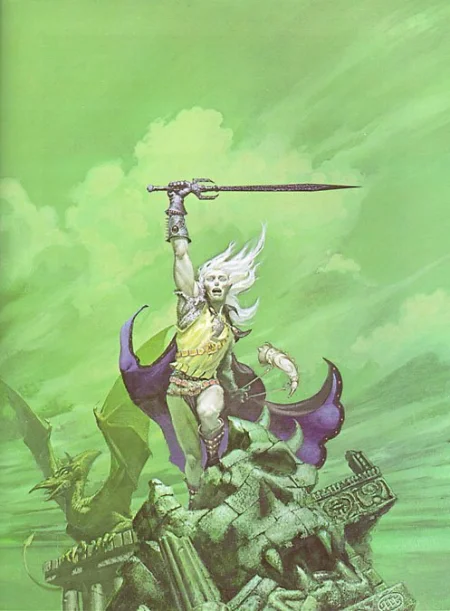
In this post, I quoted,
without context, a few passages from Michael Moorcock’s The Weird of the White Wolf, in which Elric muses on law, chaos,
and the balance between the two. Moorcock’s Elric stories are the basis for the
original D&D alignment system (lawful/neutral/chaotic), and though the
D&D alignment system has taken on a life of its own over the course of the
past 40 years, understanding its origins in Moorcock’s writing is vital to
understanding what it actually means to be “lawful” or “chaotic.”
In the first passage,
Elric describes his desire for stability, for order, in the universe. The world
is a chaotic place, and Elric searches for meaning in the meaningless swirl of
events. Ultimately, however, he decides that there is no lasting order, that
chaos reigns: “our brief existence is both meaningless and damned.” Given this
truth, he trusts “only in my sword and myself.”
Between the poles of law
and chaos, there is another cosmic outlook: neutrality. To be “neutral” in the
struggle between law and chaos is to believe that a balance of these two
extreme forces is necessary.
The “True Neutral”
alignment makes sense within this context. True neutrality is not a belief in
the balance between good or evil, in which someone feels the need to balance a
benevolent act with a malevolent one—to tip the scales toward goodness by
saving an innocent life and then redress this imbalance by murdering an innocent—but
a belief in the balance between law and chaos.
In the neutral disposition, too much law leads to
stagnation, but too much chaos leads to dissolution. Rigid bureaucracies need
to be shaken up once in a while lest they ossify into reflexive traditionalism, and
even in an anarchist society hierarchies must form now and then to accomplish
certain goals.
Looking at it this way,
neutrality seems like a fairly sensible, even common-sense, position to take. The vast
majority of NPCs would likely be neutral, avoiding the extreme positions of law
and chaos and instead favoring a pragmatic balance between the two.
A follower of Law, on the other hand, would
reject anarchism outright, believing that “without law nothing material is possible,” and that meaning and purpose are inherent within the lawful structure of the universe, while a follower of Chaos would see seemingly “lawful”
natural events such as the movements of the planets as ultimately transitory in
the grand scheme of things. Everything that seems permanent eventually crumbles
into dust, and from that dust, new patterns emerge, but not because of any
cosmic order, but by sheer accident.

Even within the
nine-alignment system, understanding law and chaos in this manner makes
alignment make sense. The lawful/neutral/chaotic axis is a cosmic philosophical
outlook, and the good/neutral/evil axis represents a character’s actions in the
context of their philosophical beliefs.
For example, Elric sees
only chaos in the universe, and so chooses to trust only in himself. That seems
like a chaotic neutral disposition to me, not chaotic evil, as the original Deities & Demigods surmises.
A chaotic evil response
to the universal rule of Chaos would be, “nothing matters, nothing means anything,
so I am free to lie and steal and kill and do whatever I want because all laws
are fake.”
A chaotic good character
would see the chaos inherent in the universe and say that because Chaos reigns,
Law does not have a monopoly on righteousness. In fact, Law only leads to
stagnation, a slavish devotion to tradition, and a constraining of freedom and
progress.
So in light of Elric’s
ruminations on Law and Chaos, I would explain alignment this way: lawful,
neutral, and chaotic describes how you believe the universe functions; good,
neutral, and evil describes how you act out those beliefs.